

Test



Strengthening Health Centers to Support Healthier Communities
Capital Link is a national, non-profit organization that has worked with hundreds of community health centers and Primary Care Associations (PCAs) for nearly 30 years to plan for sustainability and growth, access capital, improve and optimize operations and financial management, and articulate value. Established through the health center movement, Capital Link is dedicated to strengthening health centers—financially and operationally—in a rapidly changing marketplace. Learn More >
Events



A Quarterly Resource Bulletin from Capital Link
Winter 2016 Issue 
Message from the CEO
Allison Coleman, CEO
2015 was certainly a roller coaster ride, with many highs and lows: we celebrated the 50th anniversary of the health center movement and fixed the Primary Care Cliff, while also weathering threats to the annual appropriation and attempts to repeal the Affordable Care Act. Throughout the year, the health center family showed its resilience as we faced these hurdles together. What’s encouraging is the steadfast commitment to the health center mission and the many ways health centers are growing and improving to meet the needs of their communities.
As we begin 2016, Capital Link applauds the achievements of health centers and offers information that may help ongoing efforts to expand access to care and impact patients’ overall well-being. This issue contains a call for health centers to apply to participate in a new Healthy Futures Fund Readiness program, and highlights our new report exploring the relationship between financial, clinical and operational excellence at America’s health centers. We also provide new resources, including an updated infographic illustrating the growing economic impact of health centers nationwide.
We’d like to update you on a few staffing changes here at Capital Link and our lending affiliate, Community Health Center Capital Fund. Mary Ann Wayne, Director of Loan Programs at Capital Fund, will be retiring this spring. We’re grateful for her six years of hard work and dedication and wish her all the best in this next chapter in life. Brandon Boyle has joined us as Capital Fund’s new Director of Loan Programs, bringing strong CDFI and banking experience. We’d also like to welcome Muna Majekodunmi as Capital Link’s new Boston-based Staff Accountant, and Dale S. Johnson, who will join our California-based team in the spring as Consultant, Financial and Operations Improvement. We’re delighted to have them aboard.
As always, there’s also an update on the latest federal issues, health center highlights, and a list of upcoming trainings and presentations (we hope to see you at the NACHC Policy and Issues Forum—visit us at booth #217). Best wishes for a successful 2016!
Federal Update
Keep Up to Date!
Below is a selection of recent health policy and regulatory news and information relevant to health centers and PCAs. For regular updates, subscribe to Capital Link’s blog and access the following links:
NACHC’s Health Centers on the Hill and Policy Shop blogs
The Health Resources and Services Administration’s health center tab
The newsroom at the U.S. Department of Health and Human Services
FY17 Budget Proposes Funding for Health Centers through FY19
On February 9, 2016, it was announced that the President’s FY 2017 budget proposes a total of $5.1 billion in funding for Community Health Centers, including $1.35 billion in discretionary funds and $3.75 billion in mandatory funds. The budget also calls for extensions of mandatory funding for health centers for two additional years beyond the funding currently in place through FY17. Read more, including NACHC's statement on this proposal, here.
FY16 Omnibus Appropriations Legislation Includes Funding for Health Center Growth
On December 17, 2015, after long negotiations, Congress passed a $1.8 trillion spending package, which includes discretionary funding of almost $1.5 billion for the Health Center Program. This is in addition to the $3.6 billion in mandatory funding provided earlier this year through H.R. 2. The legislation specifies that no less than $150 million be spent on construction and capital improvements and no less than $200 million be spent on expansions of health center capacity, including new delivery sites and the addition of services such as dental and behavioral health. Read more here and here.
New Markets Tax Credit Program Updates
FY17 Budget Proposes to Make the NMTC Permanent at $5 Billion in Authority
February 9, 2016 – The President's fiscal year (FY) 2017 budget includes a proposal for the permanent extension of the New Markets Tax Credit Program (NMTC), which promotes investments in low-income communities, providing $5 billion in annual allocation authority. Read the more on the NMTC Coalition blog.
Five-Year NMTC Program Extension
On December 18, 2015, the House and Senate passed the Protecting Americans from Tax Hikes Act (PATH Act) for FY16, which includes a five-year extension of the NMTC Program at an allocation level of $3.5 billion annually. Read more here.
NMTC Coalition Celebrates 15th Anniversary of the NMTC
On December 21, 2000, President Bill Clinton celebrated the signing of H.R. 4577, appropriations legislation that included the provisions of the Community Renewal Tax Relief Act and the New Markets Tax Credit. Since then nearly $75 billion in capital has flowed to distressed rural and urban communities nationwide. Health centers have benefitted from almost $1 billion in financing through the NMTC program. A video of President Clinton's 2000 speech can be found here.
CMS Announces Funding Opportunity to Discover How Addressing Social Needs can Improve Health
On January 5, 2016, the Department of Health and Human Services announced a new funding opportunity of up to $157 million to test whether screening for health-related social needs and facilitating navigation of community-based services will improve quality and affordability in Medicare and Medicaid. The goal of the five-year Centers for Medicare & Medicaid Services (CMS) Innovation Center program, called the Accountable Health Communities Model, is that beneficiaries struggling with unmet health-related social needs are aware of the community-based services available to them and receive assistance accessing those services. A link to the funding announcement can be found here.
New and Noteworthy
Health Centers Invited to Apply to Healthy Futures Fund Readiness Program
The Healthy Futures Fund (HFF), a collaboration between the Local Initiatives Support Corporation (LISC), Morgan Stanley, and The Kresge Foundation that launched in 2012, recently announced that it will invest an additional $100 million in projects that promote healthy communities and address the social determinants of health. Utilizing New Markets Tax Credit (NMTC) financing, HFF is seeking to finance innovative, groundbreaking projects that will serve as models for the unique ways in which FQHCs are collaborating with partners to improve the health of their communities.
Ideal projects can best be defined as “gazelle projects,” or FQHC-sponsored capital projects that are ahead of the pack, moving quickly to address the social determinants of health in their communities; characterized by nimble leadership, discerning vision and swift progress. Projects should involve collaborations between health centers and other community partners that expand access to health care while also addressing at least one other critical community need, such as affordable housing, access to healthy food, job training, schools, elder care and other projects to advance community wellness.
In addition to providing attractive financing, HFF is offering a free HFF Readiness Program, sponsored by LISC and Kresge, for a limited number of FQHCs interested in obtaining financing through the HFF. Offered through Capital Link, the HFF Readiness Program is available to select health centers through a competitive application process; those that successfully complete the technical assistance program will be eligible for HFF grant funding to advance their project planning.
Health centers are invited to apply to participate in the HFF Readiness Program by accessing our call for proposals here. Applications are due March 4, 2016.
Learn more by visiting the Healthy Future Funds website or Capital Link’s Healthy Futures Fund Readiness Program webpage. Contact Jonathan Chapman, Capital Link’s Director of Community Health Center Advisory Services at This email address is being protected from spambots. You need JavaScript enabled to view it. for details.

Help Us Report on the Capital Needs of Health Centers!
For the past seven years, Capital Link has conducted a study, with support from HRSA, to determine the extent of existing and future health center capital needs and funding requirements. By providing an estimate of the additional capital investment required for health centers to meet growth targets, this national capital needs assessment helps focus attention on the evolving needs of health centers as they work to support high-quality patient care.
Your participation helps:
-
Quantify the capital needs of health centers nationally in order to inform public sector stakeholders;
-
Encourage private sector foundations and lenders to develop new funding sources to help health centers meet their needs;
-
Identify new or emerging needs, beyond “brick and mortar” capital — such as working capital to support rapid growth or acquisition of private practices;
-
Identify areas for additional technical assistance to help your health center reach development goals; and
-
Position your health center to receive information on emerging funding sources targeted to your specific needs.
We’re preparing to send our new assessment to all health centers in a few weeks, so stay tuned! Your assistance in this important effort is greatly appreciated.
Resources
New Study Examines the Relationship between Health Center Clinical, Financial, and Operational Excellence
Health centers are experiencing greater demands on their services as health reform implementation proceeds, often necessitating growth and operational transformation. As their role as key providers of primary care increases, health centers need to assess their current performance and develop strategies for improvement. Prior Capital Link studies have provided health centers, Primary Care Associations, and other stakeholders with insight into financial and operational trends. This analysis furthers our knowledge by examining the operating models, strategies, and practices of high-performing health centers to better understand the factors that work for and against the co-occurrence of strong clinical performance and financial sustainability.
This research sought to answer the following questions for the first time:
1. Do health centers that excel in providing high-quality patient care do better or worse than other health centers financially?
2. What are the characteristics of health centers that achieve both high-quality care and strong financial results?
3. What do high-performing health centers do differently or better than their peers?
The results of this analysis show that it is possible to reach quality targets while also performing well financially. Quality Awardee health centers achieve key quality targets and invest more in enabling staff and services, but are also able to produce strong financial results through revenue maximization, efficient medical care teams, and higher utilization through positive engagement with patients. The data further indicates that the highest performers have a greater ability to control costs—in particular, staffing costs—even though they are more heavily staffed with generally higher-cost physicians.
Key findings are illustrated in our infographic. Access a free download of the complete report at www.caplink.org/resources/publications.

New National Economic Impact Analysis and Special Pricing for State and Individual EIAs
Using economic modeling software, an Economic Impact Analysis (EIA) measures the effect a health center’s current operations has on the communities it serves, including job creation, tax impact, and cost savings. Health centers and PCAs have used this information in the past to educate policymakers, seek community support, and pursue funding opportunities.
In preparation for the upcoming NACHC Policy and Issues Forum, Capital Link updated the National Economic Impact Analysis with the latest data and is offering discounted pricing on our statewide and individual EIA reports. In order to receive your EIA before the P&I, you must submit all necessary information by February 28th. To find out more and order, please contact Steve Rubman, Director of Data and Information Systems, at This email address is being protected from spambots. You need JavaScript enabled to view it..
NACHC Payment Reform Readiness Assessment Tool
The NACHC Payment Reform Readiness Assessment Tool identifies key competency areas needed for successful health center engagement in the most prevalent and emerging payment reform models. It is designed to help health centers assess their current state of readiness, and to identify areas for improvement. The tool is not specific to one payer type or payment reform model. Rather, it is designed to capture core readiness areas that are needed for participation on in a variety of payment reform models in use by both public and private payers. The readiness assessment tool is designed to begin the conversation among health center leadership and staff about successful engagement in payment reform models. Access it here.
Brand new CHroniCles Website
CHroniCles, the dynamic, multi-media website dedicated to the living history of the community health center movement, is newly redesigned. The updated website improves overall user experience and allows visitors to better access the site on mobile and tablet devices. Check out the newly launched site here.
Coming Soon from Capital Link:
- Creating a Culture that Sustains a Patient-Centered Medical Home (Publication)
- Informing the Development of a Patient-Centered Medical Home Facility (Publication)
Health Center Highlights
Capital Link regularly profiles health centers that have successfully completed their expansion plans. These health center stories are available on our website. Upcoming additions include Neighborhood Health Association, OH, and Family Healthcare of Hagerstown, MD (formerly Walnut Street Community Health Center).
MLCHC Celebrates 50th Anniversary of US Health Centers
Massachusetts League of Community Health Centers (MLCHC) 50th anniversary op-ed is printed in the latest edition of CommonWealth Magazine. The piece focuses on how health centers are already living in the future of health care as a result of the seeds sown 50 years ago with the founding of the nation's first medical home at Columbia Point, Dorchester. Read the article here. Also, MLCHC’s Jim Hunt & Harbor Health Services, Inc.'s Dan Driscoll shared the Community Health Center Movement story with WCVB in Boston. Watch here.
Geiger Gibson Health Center, 50th Anniversary
December 14, 2015 marked the 50th Anniversary of Geiger Gibson Community Health Center, originally the Columbia Point Health Center, and the first community health center in the nation. We congratulate their momentous achievement made possible by patients, staff, community partners, and legislative champions. #CHC50!
NEW Health Charlestown, MA Opens New Facility
Capital Link would like to congratulate NEW (North End Waterfront) Health, MA, on the grand opening of a new facility in Charlestown, MA. NEW Health Charlestown will offer a range of services, which include adult primary care, behavioral health, vision and dental services, among others. Capital Link's lending affiliate, Community Health Center Capital Fund, provided financing for this new site.
Upcoming Events
Industry Presentations
Capital Link regularly presents information at industry conferences. Below are a few of our next scheduled events. Complete descriptions are available here on our website.
|
NACHC 2016 Policy and Issues Forum Booth Number: 217 |
Identifying the Drivers of Maximum Performance
Thursday, March 17th, 8:30 - 10:00am
Presenters: Jonathan Chapman, Director of Community Health Center Advisory Services, Capital Link; Charles Moore, President, HealthMETRICS
Read more here.
Hallmarks of High Performance: Exploring the Relationship between Clinical, Financial, and Operational Excellence at America’s Health Centers
Thursday, March 17th, 10:30 am - 12 pm
Presenters: Allison Coleman, Chief Executive Officer, Capital Link; Robert Urquhart, Chief Financial Officer, Greater Lawrence Family Health Center
Read more here.
Predictive Analytics
Friday, March 18th, 8:00 - 9:30 am
Presenter: Jonathan Chapman, Director of Community Health Center Advisory Services, Capital Link
Read more here.
OCHIN 2016 Learning Forum
Portland, OR
April 14-16, 2016
Hallmarks of High Performance at America’s Community Health Centers
Friday, April 15th, breakfast keynote session
Presenter: Allison Coleman, CEO, Capital Link
Read more here.
2016 Community HealthCare Association of the Dakotas Annual Conference
Fargo, ND
May 3-4, 2016
“Health Center Strong”: Hallmarks of Operational Excellence at America’s Community Health Centers
Monday, May 3rd
Presenter: Jonathan Chapman, Director of Community Health Center Advisory Services, Capital Link
Read more here.
Northwest Regional Primary Care Association Spring Primary Care Conference
Portland, OR
May 16-19, 2016
Hallmarks of Operational Excellence—Using benchmarking techniques and operational improvement tools for effective high-quality operations
Monday, May16th
Presenter: Jonathan Chapman, Director of Community Health Center Advisory Services, Capital Link
Read more here.
Trainings
Advancing the Financial Strength of California Clinics: 200 Series
February 25-26, 2015
Los Angeles, CA
This fourth installment of the Advancing Financial Strength Project: 200 Series Traning seeks to support Los Angeles’s community clinics and health centers in improving their financial position and internal financial acumen. This project is funded by L.A. Care Health Plan, Cedars-Sinai, and Blue Shield of California Foundation.
PCA Conferences
2016 Community Clinic Association of Los Angeles County Annual Health Care Symposium
April 1, 2016
Costa Mesa, CA
2016 Massachusetts League of Community Health Centers Community Health Institute & Exhibit Fair
May 4-6 2016
Falmouth, MA
California Primary Care Association Chief Financial Officers Conference
May 17-18, 2016
Carlsbad, CA
Webinars
Capital Link offers seasonal series of webinars designed to offer useful information for health centers on a wide range of topics. The webinars have no charge, but participation is limited to the first 100 registrants. Please check our website soon for a description of our upcoming webinars.

A Quarterly Resource Bulletin from Capital Link
Spring 2016 Issue
Message from the CEO
Allison Coleman, CEO
With today's advances in data and technology, many industries are now able to move beyond simply tracking the past to anticipating the future and even predicting behavior. In this issue, the article How Health Centers Can Use Predictive Analytics, discusses how more and more health centers are using this concept to improve patient care, reduce costs, and negotiate favorable contracts with payers.
Also in this issue, we are making another plea for participation in our annual national capital needs assessment. Even if you don’t have any plans for capital projects in the near future—or if your plans are still preliminary—we urge you to complete this very short survey. We know you are busy, so we’ve reduced the survey to just five questions. Your participation is greatly appreciated!
We also congratulate the ten health centers chosen to participate in the Healthy Futures Fund Readiness Program, a technical assistance program for health centers seeking to advance their innovative, co-located projects through Healthy Futures Fund (HFF) financing. Details on the participating centers and the program are included in this issue.
As always, this issue contains a federal update, links to new resources, health center highlights, and a list of our upcoming events and webinars. We hope you find this information helpful.
Federal Update
Keep Up to Date!
Below is a selection of recent health policy and regulatory news and information relevant to health centers and PCAs. For regular updates, subscribe to Capital Link’s blog and access the following links:
NACHC’s Health Centers on the Hill and Policy Shop blogs
The Health Resources and Services Administration’s health center tab
The newsroom at the U.S. Department of Health and Human Services
HHS Awards over $260 Million to Health Centers Nationwide to Build and Renovate Facilities to Serve More Patients
On May 4, 2016, HHS Secretary Sylvia M. Burwell announced over $260 million in funding to 290 health centers in 45 states, the District of Columbia, and Puerto Rico for facility renovation, expansion, or construction. These awards will allow health centers to renovate or acquire new health center clinical space to help provide care to over 800,000 new patients nationwide. This investment builds on the nearly $150 million awarded to 160 health centers from the Affordable Care Act’s Community Health Center (CHC) Fund for construction and/or renovation in September 2015. To view a list of the award winners, click here.
HHS Awards $94 Million to Health Centers to Improve Substance Abuse Services
On March 11, 2016, HHS Secretary Sylvia M. Burwell announced $94 million in Affordable Care Act funding to 271 health centers in 45 states, the District of Columbia, and Puerto Rico to improve and expand the delivery of substance abuse services in health centers, with a specific focus on treatment of opioid use disorders in underserved populations. This investment is expected to help awardees hire approximately 800 providers to treat nearly 124,000 new patients. For more information on these awards, including a list of award winners, click here.
Aligning Reporting of Clinical Quality Measures
On February 18, 2016, the Centers for Medicare & Medicaid Services (CMS) and America’s Health Insurance Plans (AHIP), as part of a broad Core Quality Measures Collaborative of health care system participants, released seven sets of clinical quality measures. These measures support multi-payer alignment, for the first time, on core measures primarily for physician quality programs. This work is informing CMS’s implementation of the Medicare Access and CHIP Reauthorization Act of 2015 (MACRA) through its measure development plan and required rulemaking, and is part of CMS’s commitment to ensuring programs work for providers while keeping the focus on improved quality of care for patients. Learn more here.
New Access Point Funding Opportunity
HRSA recently announced the 2016 New Access Point (NAP) funding opportunity, which provides operational support for new primary health care service delivery sites. Subject to the availability of appropriated funds, HRSA anticipates awarding approximately $50 million to support an estimated 75 New Access Point awards in Fiscal Year 2017. The maximum annual funding that can be requested in a NAP application is $650,000. NAP applications must be submitted via Grants.gov by June 17, 2016. Supplemental materials are due July 15, 2016. Awards will be announced prior to the Jan. 1, 2017 start date. The funding opportunity announcement and guidance can be found here.
New Markets Tax Credit Program Update: CDFI Fund Combines 2015 and 2016 Rounds
On April 18, 2016, the Community Development Financial Institutions Fund (CDFI Fund) announced it is combining the calendar years 2015 and 2016 New Markets Tax Credit Program (NMTC Program) allocation authorities into one allocation round and increasing the awards from $5 billion to $7 billion. The CDFI Fund will not re-open the combined 2015-2016 round for new applications. All allocation determinations will be made from the existing pool of applications submitted for the 2015 round. The CDFI Fund received 238 applications requesting an aggregate total of $17.6 billion in NMTC allocation authority. By combining the 2015 and 2016 allocation rounds, the CDFI Fund will be able to announce the allocation of New Markets Tax Credits in the year for which they are authorized, and will be able to help more communities access the benefits of the tax credits sooner. Currently, the CDFI Fund anticipates announcing the CY 2015 – 2016 NMTC Program allocations in late 2016. Read more here.
If your health center has a capital project on the horizon, now is the time to act! To find out how Capital Link can help your health center capitalize on this financing option, please contact Jonathan Chapman, Director of Community Health Center Advisory Services at 970-833-8513 or This email address is being protected from spambots. You need JavaScript enabled to view it.. We expect to offer a series of NMTC readiness workshops and free technical assistance this summer, so let us know if you are interested in participating. Details will be announced shortly.
To learn more about the NMTC program and how it works, access our resource Spotlight on Capital Resources: New Markets Tax Credit Program Update. Also note, we plan to release a new NMTC resource in the next few weeks, so keep an eye out for our email announcement.
CMS Announces Funding Opportunity to Discover How Addressing Social Needs can Improve Health
On January 5, 2016, the Department of Health and Human Services announced a new funding opportunity of up to $157 million to test whether screening for health-related social needs and facilitating navigation of community-based services will improve quality and affordability in Medicare and Medicaid. The goal of the five-year Centers for Medicare & Medicaid Services (CMS) Innovation Center program, called the Accountable Health Communities Model, is that beneficiaries struggling with unmet health-related social needs are aware of the community-based services available to them and receive assistance accessing those services. A link to the funding announcement can be found here.
New and Noteworthy
Health Centers Selected for Healthy Futures Fund Readiness Program
We’re delighted to announce that ten innovative health centers have been selected to participate in the Healthy Futures Fund Readiness Program, a technical assistance program offered through Capital Link to prepare health centers for Healthy Futures Fund (HFF) financing. The HFF is a $200 million collaboration between the Local Initiatives Support Corporation (LISC), Morgan Stanley and The Kresge Foundation designed to promote healthy communities—with capital financing resources specifically designated for Federally Qualified Health Centers (FQHCs) that are addressing the social determinants of health through a co-location model.
Participating health centers include:
-
Alivio Medical Center with The Resurrection Project, Chicago, IL
-
Blackstone Valley Community Health Care, Central Falls, RI
-
El Centro del Barrio (dba CentroMed), San Antonio, TX
-
Esperanza Health Centers, Chicago, IL
-
First Choice Community Healthcare, Albuquerque, NM
-
Hill Country Community Clinic, Redding, CA
-
Legacy Community Health with Avenue Community Development Corp., Houston, TX
-
NOELA Health Center with Mary Queen of Vietnam, New Orleans, LA
-
New Economics for Women (possible collaboration with Arroyo Vista Family Health Center), Los Angeles, CA
-
Primary Health Network with Midland Development Corp., Midland, PA
The selected health centers have planned projects that combine access to health care with a variety of services designed to address broader community concerns, including affordable and/or supportive housing; physical fitness and wellness centers; community gardens, urban farms and healthy foods; early childhood education and charter schools; and financial, technology and employment training.
The HFF Readiness Program has two primary components:
1. Group Learning: Webinars will provide education on New Markets Tax Credit (NMTC) financing, particularly through HFF, and what it takes to be ready to successfully obtain financing. Participants will also benefit from the experiences of other health centers that have taken on projects to address the social determinants of health — and have obtained NMTC financing to advance these projects.
2. Individualized Advisory Services: Capital Link consultants will help participants understand whether or not the HFF NMTC financing structure would be advantageous for their needs, and if so, develop a specific work plan to achieve readiness for financing. This assistance includes identifying areas of needed operational or financial improvement to be addressed through the planning grant phase.
Those that successfully complete the HFF Readiness Program will be eligible to apply to LISC for grant funding to advance their capital project planning and can be considered for financing through HFF. Congratulations to all participants!
How Health Centers Can Use Predictive Analytics
Using data and technology, organizations can now move beyond simply tracking the past to anticipate the future through the use of predictive analytics, technology that learns from experience [data] to predict the future behavior of individuals in order to drive better decisions. Predictive analytics is now becoming more applicable to health care, and will eventually become essential for health centers to improve patient care, reduce costs, and negotiate favorable contracts with payers.
Health Centers can utilize predictive analytics in a multitude of ways, furthering its consideration and implementation of patient engagement, patient compliance, chronic disease management, regulatory compliance, avoidable deaths, hospital readmissions, public health, waste and abuse, and health outcomes. And this is only the beginning. Clearly predictive analytics is in its infancy within health care, and the exponential pace of technological advancements will identify additional uses and benefits we have yet to consider.
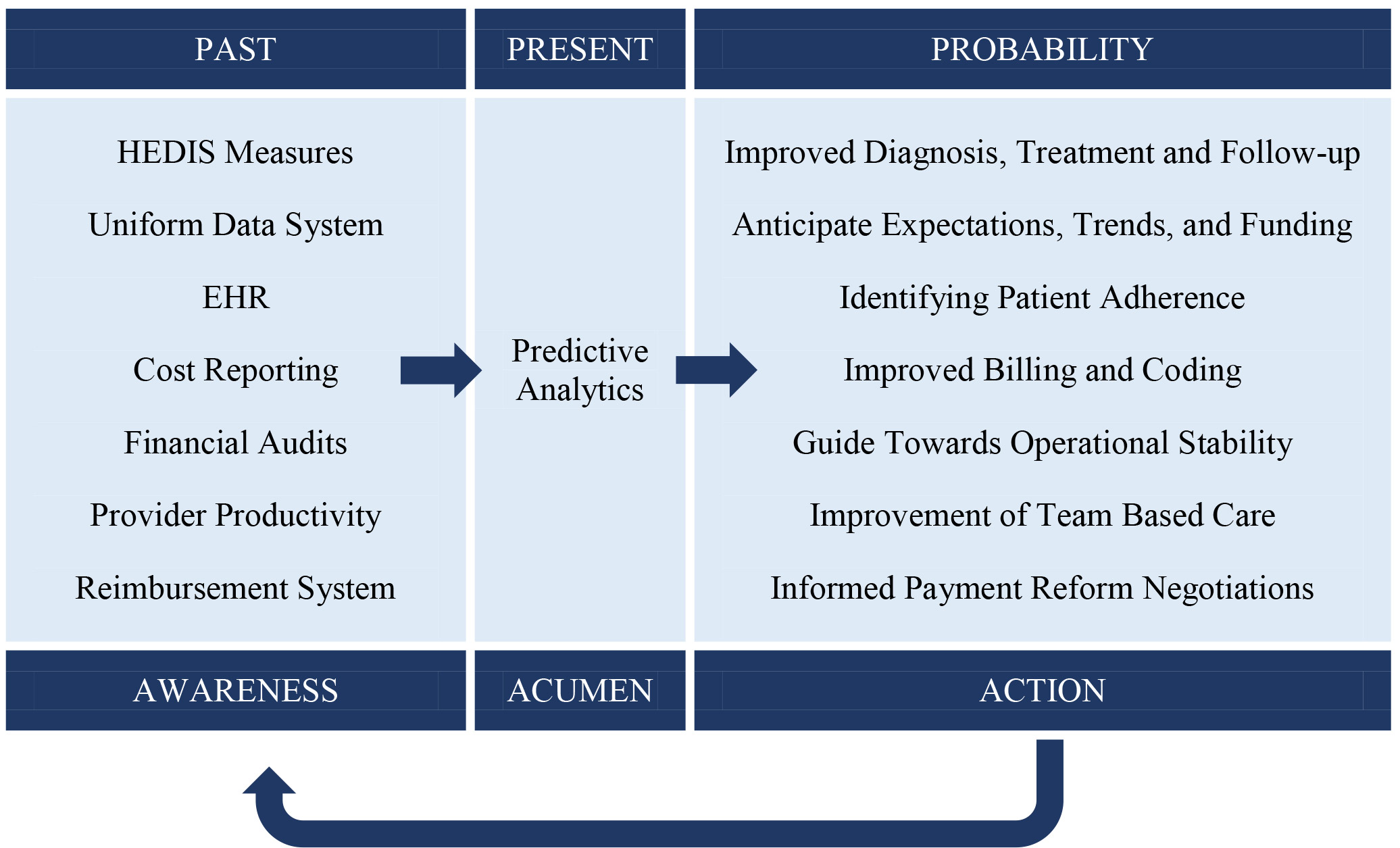
Capital Link and NACHC are putting the finishing touches on a new resource on predictive analytics that is not intended to provide instruction on coding or building predictive models, but will:
-
Define predictive analytics
-
Provide an overview of its history and development
-
Address the data and resources needed to predict a patient’s future behavior
-
Identify how a health center can begin utilizing it
-
Include specific examples of how it has been successfully used
-
Clarify health centers’ understanding and expectations of predictive analytics
Just 5 Brief Questions to Help Us Update Our National Capital Needs Assessment
Capital Link is updating our national capital needs assessment, with support from HRSA, to help document the need for health center capital funding and identify areas where technical assistance, training, or other resources may be needed.
The participation of all US health centers is critical! Even if you don’t have plans for a facility expansion project in the near future—or if your project plans are still preliminary—your participation is still important.

(It should take no more than a few minutes to complete.)
Access the results from our last national capital needs assessment, Capital Plans and Needs of Health Centers: A National Perspective, here on our website.
Thank you for your assistance in this important effort.
Resources
New Reports Examine the Financial and Operational Trends of California Health Centers
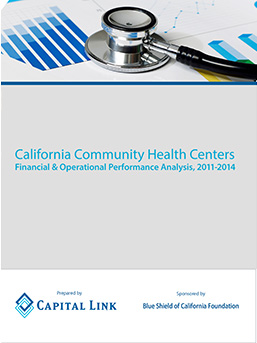
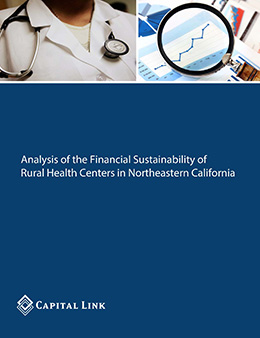
Capital Link announces the release of an updated statewide financial and operational profile and an analysis of the financial sustainability of rural health centers in Northeastern California. These resources, sponsored by Blue Shield of California Foundation, highlight data trends in an effort to identify opportunities to ensure financial sustainability, particularly given the changing nature of the healthcare landscape. We are scheduling webinars in June to review key findings from these studies. Stay tuned for more information!
California Community Health Centers: Financial & Operational Performance Analysis, 2011-2014 updates Capital Link’s statewide, multi-year financial and operational profile to promote performance improvement. Click here to download the report.
Analysis of the Financial Sustainability of Rural Health Centers in Northeastern California sheds light on the unique challenges confronting frontier and rural health centers and offers ideas for strengthening operations. Click here to download the report.
New NACHC Research Department Resources
Staffing the Safety Net: Building the Primary Care Workforce at America’s Health Centers: This new report presents results from NACHC's recent national health center survey of health center clinical vacancies, hiring priorities, and recruitment and retention experiences. If all health center clinical vacancies were filled today, health centers could serve two million more patients. Click here to access the report.
Updated State Fact Sheets: NACHC’s recently updated fact sheets provide a brief overview of what health centers are, the most important state-level data available on health center patients, services provided, staff, patient visits, and costs of care. A national profile is also available. Click here and find your state on the map at the bottom of the page. Find NACHC fact sheets and infographic here.
Find summaries of research articles related to different community health center topics—quality of care, improving access to care, and cost-effectiveness—here.
Coming Soon from Capital Link:
- Spotlight on Capital Resources: New Markets Tax Credit Program Update 2 (Publication)
- Predictive Analytics: An Overview for Health Centers (Publication)
- Creating a Culture that Sustains a Patient-Centered Medical Home (Publication)
- Informing the Development of a Patient-Centered Medical Home Facility (Publication)
Health Center Highlights
Capital Link regularly profiles health centers that have successfully completed their expansion plans. These health center stories are available on our website. Recent additions include Neighborhood Health Association, OH, and Family Healthcare of Hagerstown, MD (formerly Walnut Street Community Health Center).
GE to Invest in Massachusetts Community Health Centers...
On April 4, 2016, amidst plans to relocate its global headquarters from Connecticut to Boston, MA, GE announced it will be making $50 million in philanthropic donations in Massachusetts over the next five years. The company specified a commitment to donating $15 million through its GE Foundation to expand capacity and increase specialty care training at Massachusetts community health centers. As a part of this funding, GE will also be building the first-ever Community Health Center Leadership and Skills Institute, which will offer training for health centers across the state on leadership, team-based care, and the use of technology to improve patient outcomes. Read more here.
Upcoming Events
Events
National Health Center Week 2016 is August 7-13 and Capital Link is proudly sponsoring this important event. This year's theme is Celebrating America's Health Centers: Innovators in Community Health.
Industry Presentations
Capital Link regularly presents information at industry conferences. Below are a few of our next scheduled events. Complete descriptions are available here on our website.
Northwest Regional Primary Care Association Spring Primary Care Conference
Anchorage, AK
May 14-17, 2016
Hallmarks of Operational Excellence - Using Benchmarking Techniques and Operational Improvement Tools for Effective High-Quality Operations
Monday, May 16th
Presenter: Jonathan Chapman, Director of Community Health Center Advisory Services, Capital Link
Read more here.
California Primary Care Association Chief Financial Officers Conference
Carlsbad, CA
May 18-19, 2016
Strengthening Health Center Collections through Effective Revenue Cycle Management
Wednesday, May 18
Presenter: Dale Johnson, Project Consultant, Capital Link; and Patricia Aguilera, Chief Financial Officer, La Clinica de la Raza
Read more here.
Mid-Atlantic Association Of Community Health Centers Semi-Annual Conference
Annapolis, MD
June 16, 2016
Market Assessment and Payer Mix Modeling in an Era of Health Reform
Thursday, June 16, 3:15-4:15 pm
Presenter: Rebecca Polan, Project Consultant, Capital Link
Read more here.
Missouri Primary Care Association Annual Clinical & Quality Conference
Branson, MO
September 24, 2016
Hallmarks of High Performance: Exploring the Relationship between Clinical, Financial and Operational Excellence at America’s (and Missouri’s) Health Centers
Saturday, September 24, 2016, 8:30-10:00 am
Presenter: Allison Coleman, Chief Executive Officer, Capital Link
Webinars
Capital Link offers seasonal series of webinars designed to offer useful information for health centers on a wide range of topics. The webinars have no charge, but participation is limited to the first 100 registrants. Please check our website for complete descriptions of all upcoming webinars.
California Health Center Performance Update
Wednesday, June 1, 2016, 1-2 p.m. PT (Hosted by CPCA)
Presenters: Tony Skapinsky and Dale S. Johnson, Project Consultants, Capital Link
Register here.
Financial Sustainability for Rural Health Centers in Northeastern California
Thursday, June 9, 2016, 1-2 p.m. PT (Hosted by CPCA)
Presenter: Jonathan Chapman, Director of Community Health Center Advisory Services, Capital Link
Register here.
Planning for Growth: Health Center Board and Staff Training
Tuesday, June 14, 2016, 2-3 pm EDT
Presenter: Jonathan Chapman, Director of Community Health Center Advisory Services, Capital Link
Register here.
Accessing Capital from Community Development Financial Institutions
Wednesday, June 15, 2016, 2-3 p.m. EDT
Presenter: Terry Glasscock, Senior Project Consultant, Capital Link
Register here.
Incorporating Capital Plans into Strategic Planning Efforts
Thursday, June 23, 2016, 2-3 p.m. EDT
Presenter: Rebecca Polan, Project Consultant, Capital Link
Register here.
Securing Affordable Financing for Your Health Care Expansion or Renovation Project (Small Group Training)
This small group training is designed to assist health centers that anticipate conducting a capital project during the next one to three years and are considering the benefits of the Health Resources and Services Administration (HRSA) Health Center Facility Loan Guarantee Program (LGP). Through a series of interactive sessions, this training provided participating health centers with guidance and tips on all key elements and requirements for submitting a HRSA LGP application.
Training sessions will be facilitated by Capital Link Project Consultants, and will be enhanced with valuable tools and resources, as well as opportunities for one-on-one guidance to help participating health centers understand specific aspects of the Loan Guaranteed Program.
November 20, 2025 | Session One: The Application Process - 12pm EST
December 04, 2025 | Session Two: Planning Principles - 12pm EST
December 11, 2025 | Session Three: Market Assessment & Scenario Planning - 12pm EST
December 18, 2025 | Session Four: The Business Plan - 12pm EST
Featured Speakers:
 |
Beth Edwards, MSN, RN, CNL, CPNP-PC, EDAC Chief Consulting Officer, Health Center Operations and Facilities Planning |
 |
Brandon Boyle Senior Director of Loan Programs |
 |
|
 |
REGISTER NOW! Space is limited.
Capital Link’s small group trainings are designed to help increase the capacity of health centers in a peer-to-peer learning format. Conducted through a series of webinars and virtual discussions facilitated by Capital Link, these trainings are offered free of charge to approved health center applicants with support from the Health Resources and Services Administration.
HRSA Loan Guarantee Program
Serves as a forum for health centers interested in financing a capital project through the Health Center Facility Loan Guarantee Program from HRSA. LEARN MORE >
Capital Development - Early Project Planning Stages
Practical direction and tools for planning, financing, and completing a capital project. LEARN MORE >
Capital Development - Late Project Planning Stages
Go beyond the basics of planning, financing, and developing health center capital projects. LEARN MORE >
Mobile Health
Explores mobile health care and the process of planning for and developing mobile units as part of health center operations. LEARN MORE >
Strengthening Facility Infrastructure and Enhancing Emergency Operations Planning
Strong facilities and effective emergency planning are essential to keeping health centers operational—especially during times of crisis. Capital Link invites you to join our national webinar focused on strategies for designing and operating high-performing health centers.
National Training to Advance Mobile Health Planning and Strengthen Care Delivery Through Mobile Units
As a HRSA National Technical Assistance Program (NTAP), Capital Link is pleased to offer this free small group training to support health centers in expanding access to care through mobile health strategies. We invite you to join this four-session training focused on planning, launching, and sustaining mobile health units as a cost-effective, community-centered approach to care delivery. Through expert guidance, practical tools, and peer learning, participants will explore key considerations for successful mobile health programs, including business planning, vehicle and maintenance needs, staffing models, community partnerships, service delivery design, and financial sustainability. Sessions will also highlight real-world examples, lessons learned, and emerging best practices from ongoing technical assistance efforts nationwide.This training is designed for health centers seeking to strengthen access, affordability, patient experience, and workforce capacity through innovative mobile care solutions. Training sessions will be facilitated by Capital Link subject matter experts, with guest partners from CohnReznick and NACHC, and will include valuable resources and opportunities for tailored guidance. REGISTER HERE>
Capital Development - Late Project Planning Stages
Go beyond the basics of planning, financing, and developing health center capital projects. LEARN MORE >
These trainings are supported by the Health Resources and Services Administration (HRSA) of the U.S. Department of Health and Human Services (HHS) as part of an award totaling $1,168,750 with 0 percent financed with non-governmental sources. The contents are those of the author(s) and do not necessarily represent the official views of, nor an endorsement, by HRSA, HHS, or the U.S. Government. For more information, please visit HRSA.gov.